High Fantasy vs Low Fantasy: Which Fits Your Story?
Not sure which fantasy genre fits your story? See how high and low fantasy differ in setting, magic, stakes and worldbuilding before you choose.
Every fantasy writer hits this wall eventually. You've got a draft open, a magic system half sketched in a notebook, and a nagging question you can't shake: what actually is this thing you're writing? Is it high fantasy? Low fantasy? Something in between that nobody bothered to name?
The anxiety is real, and it's not just a labelling problem. Pick the wrong category on a query letter or a self-publishing form, and you risk confusing readers who bought your book expecting something else entirely. Get it right, and the label becomes a promise you can actually keep.
Here's the question that trips up even experienced readers: is Harry Potter high fantasy or low fantasy? Most people assume high, because wizards and dragons and an entire hidden school system feel epic. But the wizarding world exists inside our world, hidden in plain sight on a train platform in London. That single fact changes its category completely, and it's exactly the kind of confusion this guide exists to clear up.
By the end of this piece, you'll have a working definition of both modes, a side-by-side comparison you can scan in ten seconds, a decision framework to run against your own story idea, and practical guidance on how much worldbuilding each mode actually demands. This isn't a definitions lecture. It's a decision, made clearly enough that you can get back to writing.
One honest note before we start: the high fantasy versus low fantasy split is debated among readers and genre scholars. It's a useful spectrum, not a rigid law. We'll draw on established genre definitions throughout, and we'll be upfront anywhere the line gets blurry, because pretending there's a clean answer for every book would be doing you a disservice.
What Is High Fantasy?
High fantasy takes place in a completely invented secondary world. Not a hidden layer of our world, not a version of Dublin with dragons added. A world built from scratch, with its own geography, its own history, its own physical laws, and its own magic system. The reader never touches a recognisable version of Earth at any point in the story.
That's the whole distinction, and everything else follows from it. If you remember one thing from this section, remember this: high fantasy means a secondary world with its own rules and its own history, full stop.
Key traits of high fantasy
Setting: an entirely fictional reality with no direct connection to our world.
Magic visibility: magic is woven into the fabric of the world itself. It might be common, it might be institutionalised through guilds or bloodlines, it might be ancient and half-forgotten, but it's part of how that world works, not an intrusion into it.
Stakes: often civilisational or cosmic. The fate of kingdoms, entire peoples, or the world itself tends to hang in the balance.
Tone: frequently epic, sweeping, mythic in register, though this is a tendency rather than a rule. Plenty of high fantasy runs small and intimate at the scene level while the stakes remain enormous.
Worldbuilding effort: substantial. Geography, cultures, languages, political systems, and magic rules all need enough explanation that the reader feels grounded rather than lost.
The archetypal example is Tolkien's Middle-earth, in The Lord of the Rings and The Hobbit. Middle-earth has its own geography you could draw a map of, its own deep history stretching back ages before the story starts, its own languages, and its own magic system tied to specific races and objects. Nothing in it borrows from our world.
But high fantasy is bigger than one author from the 1950s. Look at the epic fantasy shelves in any bookshop today, and you'll find secondary-world stories built around entirely invented political systems, invented religions, and invented magic that owes nothing to Tolkien's particular flavour of it. The category has grown well beyond its most famous example, and it's worth reading recent work in the subgenre rather than assuming Middle-earth is the only template.
Worth knowing: budget extra time for worldbuilding if you're writing high fantasy. Readers expect enough explanation of geography, cultures, species, laws, and magic to feel grounded in your world. The trap is dumping all of that lore in the first fifty pages. Better to let the reader discover the world the way a traveller does: piece by piece, through what the story actually needs at that moment.
What Is Low Fantasy?
Low fantasy keeps one foot in our recognisable, everyday world. The fantastic doesn't build the setting from the ground up. It arrives as an interruption into an otherwise normal reality. This is exactly why low fantasy is also called intrusion fantasy: something impossible intrudes on a world that otherwise runs on our rules.
There's a simple test here. Ask whether the magic arrives as an interruption into an otherwise normal world. If the answer is yes, you're working in low fantasy territory, whatever else is happening in the plot.
Key traits of low fantasy
Setting: our real world, or a world closely connected to it, where the magical element stands out precisely because the surrounding reality is familiar.
Magic visibility: magic is the exception, not the rule. It startles, disrupts, or hides. The mundane backdrop is what gives the fantastic its force.
Stakes: often personal, local, or contained, though they can escalate. The emotional centre tends to be about wonder or danger breaking into an otherwise ordinary life.
Tone: frequently grounded, contemporary, or historical. The familiar setting anchors the tone even once the magic shows up.
Worldbuilding effort: lighter than high fantasy. The real world does half the work already, because your reader already knows how it functions.
Harry Potter is the clean example here, and it's the one that surprises people most. Magic exists hidden inside our contemporary world. The wizarding world runs parallel to normal British society and intrudes on it, rather than replacing it. Muggle London still exists, buses still run, and that contrast is doing real narrative work.
The Lion, the Witch and the Wardrobe sits here too, and this is where things get genuinely interesting, because Narnia itself is a fully invented secondary world. Children from our world step through a wardrobe into it. The connection back to our reality, the fact that the story starts and ends in an English house during wartime, is what puts this in low fantasy territory despite Narnia being about as fantastical as it gets on its own terms. We'll come back to why the entry point matters so much in the spectrum section below.
Worth knowing: don't mistake low fantasy for low imagination. It isn't lesser fantasy. It's a deliberate structural choice that makes the impossible land with the force of an intrusion into something real, and that's genuinely harder to pull off than it sounds, because the mundane half of the story has to be convincing enough to make the magical half feel earned.
High Fantasy vs Low Fantasy: Side by Side
Here's the comparison distilled into something you can actually scan.
Trait | High Fantasy | Low Fantasy |
Setting | Fully invented secondary world with its own geography, history, and physical laws | Our recognisable real world, or a world closely connected to it |
Magic Visibility | Woven into the world's fabric; common, institutionalised, or ancient | Intrudes as the exception, not the rule; startles or disrupts |
Stakes | Often civilisational, cosmic, or kingdom scale | Often personal, local, or contained; wonder breaking into ordinary life |
Tone | Frequently epic, sweeping, mythic | Frequently grounded, contemporary, or historical |
Worldbuilding Effort | Substantial: maps, cultures, languages, political systems, magic rules | Lighter: the real world provides the familiar backdrop |
Reader Expectations | Immersion in a fully realised alternate reality; epic scope and lore depth | The jolt of the impossible arriving in a world the reader already knows |
Marketing & Discoverability | Signals epic scope and series potential, lore-rich worldbuilding | Signals contemporary or historical grounding, a relatable entry point |
Examples | The Lord of the Rings, The Hobbit | Harry Potter, The Lion, the Witch and the Wardrobe |
That table covers the theory. The next question is what happens when your story doesn't sit neatly on either side of it, because most stories don't.
The Spectrum: Why High vs Low Isn't a Simple Binary
High and low fantasy are better understood as two ends of a continuum than as a strict either-or choice. Plenty of published, successful stories sit somewhere in the middle, and several entire subgenres exist specifically because the boundary blurs.
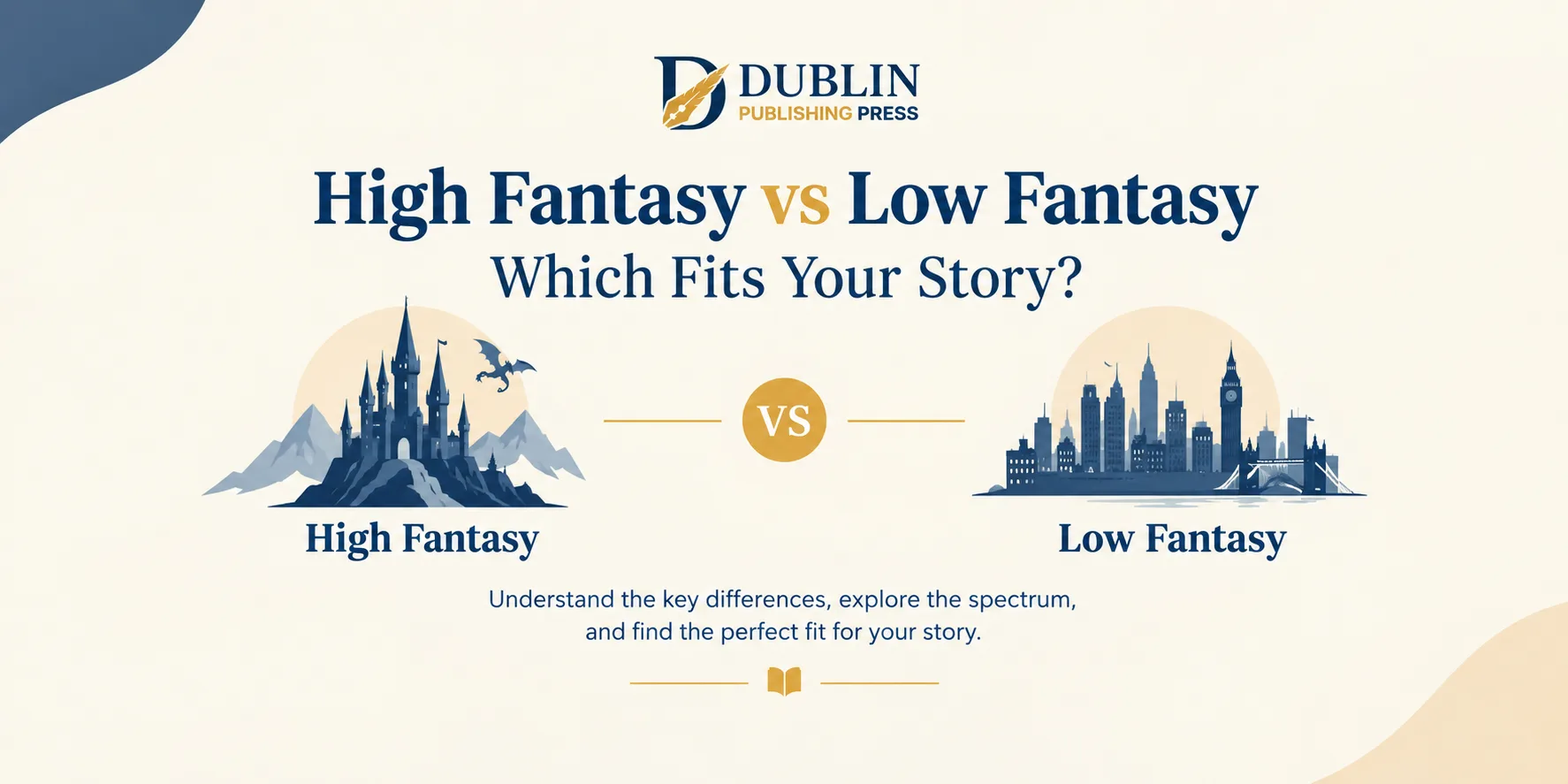
Picture a line. High fantasy sits at the far left, low fantasy at the far right, and four familiar subgenres sit at various points between them: portal fantasy leaning left of centre, historical fantasy in the middle, urban fantasy leaning right of centre, and magical realism at the far right, where the intrusion is so gentle it barely registers as an intrusion at all.
Portal fantasy: the bridge between worlds
Portal fantasy connects our world to a fictional one. Characters step through a doorway, a wardrobe, a rift, or some other threshold into a secondary world. That makes it a genuine hybrid: one foot in our reality at the point of origin, one foot in an invented world at the destination.
This is exactly the case we flagged above with Narnia. The portal origin matters more than people expect, because the reader's entry point is our world, and that entry point shapes their expectations even once the bulk of the story unfolds somewhere else entirely. Handle these hybrid cases honestly rather than forcing them into a box. The Lion, the Witch and the Wardrobe connects our world to a fictional one and is best framed as low fantasy, while The Hobbit and The Lord of the Rings, with no connection to our world at all, are high fantasy through and through.
Urban fantasy: magic in the modern city
Urban fantasy sets magical elements inside a contemporary, real-world urban environment. Magic coexists with, or hides within, modern cities, modern technology, and everyday life. It sits toward the low fantasy end of the spectrum, since the real world is the primary setting and magic intrudes on it rather than replacing it.
Urban fantasy has become one of the most commercially visible low fantasy subgenres in bookshops right now, which matters if you're thinking about how your book will be found and shelved. A story that leans hard into an urban fantasy register signals something specific to readers browsing that section, and it's worth knowing that going in.
Historical fantasy: magic layered onto real history
Historical fantasy injects magical elements into a specific historical period of our actual world. The setting is real and researchable. The magic is invented. This one sits genuinely in the middle of the spectrum, because it borrows high fantasy's worldbuilding rigour (you still need to research and render the period convincingly) while keeping low fantasy's real-world grounding (readers already know, broadly, what that period looked like).
Magical realism: the subtlest intrusion
Magical realism treats magical elements as natural, unremarkable parts of an otherwise realistic world. The magic isn't shocking or disruptive. It simply exists, and characters accept it without fanfare. That places it at the far low fantasy end of the spectrum, where the intrusion is so gentle it barely registers as an intrusion at all.
Worth flagging honestly: some readers and critics treat magical realism as its own distinct literary tradition rather than a fantasy subgenre. That's a real debate, and it's fine to hold your story loosely here rather than forcing a label that doesn't quite fit.
Which Fits Your Story? A Decision Framework
This is the part most genre explainers skip entirely, and it's the part that actually helps. Rather than handing you definitions and leaving you to guess, here's a practical checklist. Run through each step, tally which way you lean, and you'll have a clear answer for your own story by the end.
Step 1: Identify your setting
Does your story take place entirely in a world you invented from scratch? That leans high fantasy.
Does your story take place in our real world, or a recognisable version of it? That leans low fantasy.
Does your story move between our world and an invented one? That leans portal fantasy, a genuine hybrid.
Step 2: Assess magic visibility
Is magic a known, integrated part of how the world works, something characters grow up expecting? Leans high fantasy.
Is magic rare, hidden, or disruptive to the normal order of things? Leans low fantasy.
Is magic so subtle that characters barely notice it happening? Leans magical realism.
Step 3: Determine the stakes
Are the stakes civilisational, cosmic, or kingdom scale, the kind of thing that changes the map if it goes wrong? Leans high fantasy.
Are the stakes personal, local, or about wonder breaking into an otherwise ordinary life? Leans low fantasy.
Step 4: Identify the emotional core
Is the theme fundamentally about escaping or reshaping an entire world? That's a high fantasy heartbeat.
Is the theme fundamentally about wonder or danger breaking into ordinary life? That's a low fantasy heartbeat.
Decide based on your story's emotional core rather than whatever's trending this year. If the theme is about escaping or reshaping an entire world, high fantasy fits. If it's about wonder breaking into ordinary life, low fantasy fits. Trend-chasing is how books end up misfiled, and readers end up disappointed.
Step 5: Score and interpret
Count your high fantasy answers against your low fantasy answers. A clear majority in one direction gives you your category. A genuine split isn't a failure of the exercise; it's a hybrid, and hybrids are common and entirely legitimate, as the spectrum section above should have already made clear.
Matching the label to reader expectations
Once you know where your story sits, the label does real work for you. It affects how readers find your book and whether they walk away satisfied, so use whichever category best signals the actual experience you're delivering. Call a quiet, intrusion-driven story "epic high fantasy," and you'll draw readers expecting a Middle-earth-scale journey, only to hand them something intimate and contained. That mismatch shows up in reviews, and it shows up in how agents and publishers position your submission too. The category isn't just internal bookkeeping. It's the first promise your book makes to a stranger.
Worldbuilding Workload: What Each Mode Realistically Demands
This is the practical question underneath all the theory: how much work does each mode actually require before you're ready to draft?
Worldbuilding Element | High Fantasy | Low Fantasy |
Geography & Maps | Essential; you invent it and often map it | Minimal; real-world geography is already known |
Cultures & Customs | Essential; invented cultures need enough detail to feel real | Light; real-world cultures provide the foundation |
Political Systems | Often essential at kingdom or empire scale | Optional; real-world politics can be used or lightly altered |
Magic System Rules | Needs internal consistency for an entire world | Can be more mysterious or unexplained; the intrusion is the point |
History & Timelines | Often deep; invented history shapes the present | Real history provides the timeline; you add the magical layer |
Language & Naming | May need invented naming conventions or languages | Real-world languages and naming conventions apply |
Lore Delivery | High risk of info-dumping; needs careful pacing | Lower risk; the reader already knows the world's baseline rules |
High fantasy: building a world from zero
Geography and maps, cultures and customs, political systems, languages or naming conventions, species, magic system rules, history, religion and mythology all need at least a working answer before you can write with confidence. Budget extra time for this. Readers expect enough explanation of geography, cultures, species, laws, and magic systems to feel grounded, but avoid dumping it all at once in an early chapter. Build what the specific story needs first, and let the rest live in your background notes rather than the manuscript itself.
This is also where word count discipline starts to matter. High fantasy manuscripts tend to run longer simply because there's more world to establish, which is worth thinking about early if you want a realistic sense of how long your finished draft will land, and there's more detail on how word counts typically break down by category in our how many words in a novel guide.
Low fantasy: letting the real world do the work
The real world already provides the setting, the rules, the history, and the cultural context. You only need to build the magical intrusion layer on top of it. That still means working out the internal logic of the magic (even if that logic stays mysterious to the reader), the mechanics of how it hides or intrudes, and the emotional and social fallout of magic showing up inside a real-world setting.
Let the real world do half the work for you. Lean on familiar settings and everyday rules so the magical element stands out and lands with more force precisely because everything around it feels ordinary.
Practical Writing Tips for Each Mode
Pacing and lore delivery in high fantasy
The core challenge is delivering worldbuilding without info-dumping. Weave lore through action, dialogue, and character discovery rather than expository blocks that stop the story to explain the map. Keep the magic system consistent with the setting. High fantasy typically needs internally consistent rules governing an entire world, not just a single moment or object, because readers will notice the first time a rule bends without explanation.
If you're carrying a lot of invented history and world detail across a long manuscript, a professional editing pass becomes especially valuable here, since an outside eye is far better at catching the moments where you've assumed knowledge the reader hasn't been given yet. Our book editing services work through exactly this kind of consistency check on longer, world-heavy manuscripts.
Pacing and immersion in low fantasy
The familiar setting accelerates reader immersion automatically. You don't need to explain how a city works. You only need to explain how the magic disrupts it. That said, the intrusion moment itself, the exact point where magic first arrives in the normal world, functions as a key pacing and emotional beat, and it deserves to be crafted deliberately rather than rushed past.
Read recent work across urban, epic, and portal subgenres before drafting your own. Internalising how other writers handle pacing and immersion in your specific corner of the spectrum will save you from reinventing solutions that already exist.
Magic systems: consistent rules versus mysterious intrusion
The underlying difference is this: high fantasy often demands a fully articulated magic system because the entire world runs on it, while low fantasy can afford a more mysterious or unexplained magic, because the intrusion itself, not the mechanics behind it, is the point of the story. Neither approach is easier. They're just solving different problems.
The register you write in matters here too. High fantasy tends to reward a more mythic, elevated use of language and imagery, while low fantasy often benefits from prose that stays grounded until the fantastic actually arrives. If you want a refresher on how figurative language shapes tone and reader perception, our figurative language guide covers the mechanics in more depth.
Common Mistakes and Misconceptions to Avoid
Mistake: treating low fantasy as lesser fantasy. This is the misconception that causes the most self-doubt in writers. Low fantasy is not a smaller ambition. It's a deliberate structural choice, and it's arguably harder to execute well, since the mundane half of your world has to be entirely convincing before the magical half can land.
Mistake: over-building high fantasy lore. Months, sometimes years, get lost building world detail the story never actually uses. Build what the story requires. Let the rest remain in your notes rather than forcing it onto the page because you already did the work.
Mistake: mislabelling the story for marketing reasons. Calling a low fantasy book "epic high fantasy" to chase a trend, or the reverse, tends to backfire through reader disappointment, weaker reviews, and confusion at the agent or publisher stage. Match the label to reader expectations and marketing reality, not to whatever category happens to be selling this month.
Mistake: forgetting the emotional core. Writers sometimes pick a category based on what's currently popular rather than what actually fits their story, which produces a mismatch between the story's heart and its genre framework. Decide based on your story's emotional core, not trends.
Mistake: ignoring hybrid subgenres. Writers with portal, urban, or historical fantasy stories often feel pressured to pick a side when their work is genuinely hybrid. It doesn't need to be. The spectrum is real, and hybrid stories are valid and common, not a failure to categorise cleanly.
From Manuscript to Bookshelf
And if the genre research along the way sparks an idea for a companion project outside fiction, whether that's a writing memoir or a nonfiction guide to your own worldbuilding process, our book non-fiction ghostwriting services cover that route too, alongside more general book ghostwriting services if you're still deciding which form your idea should take.
Once a draft exists, a careful book proofreading services pass catches the small mechanical slips that survive even a strong edit, particularly in high fantasy manuscripts carrying invented names and terminology that spellcheck tools won't flag correctly.
Cover art carries genre signalling weight that's easy to underestimate. A high fantasy cover and a low fantasy cover tell a browsing reader two entirely different things before they've read a single line, and our book design services work specifically on getting that signal right for the category you've landed on. If your world includes maps, invented creatures, or other visual elements worth rendering properly, our book illustration services can bring those to life for readers who want to see the world as well as read it, and that's especially relevant if your project is aimed at a younger audience, where our children's book publishers team has particular experience with portal fantasy and other hybrid stories that appeal to young readers, Narnia being the obvious ancestor of that whole tradition.
Once the manuscript and cover are ready, proper book formatting services make sure the finished file behaves correctly across print and digital formats, and our Kindle publishing services handle the specific technical requirements of getting a self-published title live and discoverable. For readers who want a physical copy in hand, our book printing services cover that side of production too.
Getting the book found is its own separate challenge, and the category you settled on earlier feeds directly into it. Our book marketing services build campaigns around exactly the kind of reader-expectation signalling covered above, and a well-made book trailer services project can communicate tone and scale to a browsing reader in under a minute, which matters a great deal for a genre this visual.
Longer term, an author website design services project gives readers a home base to find your other work, and an audiobook services production opens your book to an entirely different reading audience, one that often discovers fantasy through narration and voice performance rather than the page. Dublin Publishing Press covers the full production pipeline from first draft to finished, marketed book, whichever category your story ends up in.
If you're still working out whether your idea is shaping up as a novella, a full novel, or something shorter, that decision interacts directly with how much worldbuilding you can realistically fit in, and our novella vs short story vs novel guide breaks down exactly how length and scope relate to each other.
Conclusion:
The choice between high and low fantasy comes down to four things: setting (an invented world versus our own), magic visibility (integrated versus intrusive), stakes (civilisational versus personal), and emotional core (reshaping a world versus wonder breaking into an ordinary one).
The label is a tool, not a cage. It helps readers find your book, and it helps you make consistent craft decisions as you write, but it doesn't limit what you're allowed to create. Hybrid stories are valid and common, and the spectrum framework above exists precisely to give you permission to blend modes when your story genuinely calls for it.
Run the checklist above against your own idea. Work out where it falls on the spectrum. Then start building the world your story actually needs, not the one a label told you to build. And whichever category it lands in, read recent work across urban, epic, and portal subgenres before you draft in earnest. That single habit does more for your pacing instincts than any amount of theory.
Frequently Asked Questions
Is Harry Potter high fantasy or low fantasy?
Low fantasy. The wizarding world exists hidden inside our contemporary world rather than replacing it entirely, and magic intrudes on ordinary British life rather than being the baseline reality the characters have always known.
What is high fantasy in simple terms?
A story set entirely in an invented secondary world with its own geography, history, and magic system, with no connection back to our real world at any point.
What is low fantasy in simple terms?
A story where magic intrudes on our recognisable world, or a version closely connected to it, rather than a story set in an entirely invented setting. It's often called intrusion fantasy for exactly this reason.
Is The Lord of the Rings high fantasy or low fantasy?
High fantasy. Middle-earth is a fully invented secondary world with no connection to our own, which places it firmly on the high fantasy end of the spectrum.
Can a story be both high fantasy and low fantasy?
Not both at once in the strict sense, but plenty of stories sit in the hybrid zone between the two, particularly portal fantasy and historical fantasy, which is exactly why treating the categories as a spectrum rather than a strict binary matters.
Does low fantasy mean less imaginative or lower quality?
No. The word "low" refers to the reduced presence of the fantastical relative to the real world, not to the quality or ambition of the writing. Low fantasy demands its own specific craft skill, particularly in making the mundane half of the story convincing enough to give the magic real force.
How much worldbuilding does high fantasy actually need?
Enough that readers feel grounded in the geography, culture, political systems, and magic rules of your world, delivered gradually through the story rather than all at once. Build what your specific plot requires first, and keep the rest in your background notes.
Is Narnia high fantasy or low fantasy?
It's a genuine hybrid, best classified as low fantasy or portal fantasy because the story begins and ends in our world, even though Narnia itself functions as a complete secondary world once the characters step through the wardrobe.
Have a manuscript sitting in a drawer?
Send it over. A consultant reads everything that comes in and replies within 24 hours, with an honest assessment and no obligation.
Keep Reading
DESIGN

Book Cover Design Cost in Ireland: What Irish Authors Are Really Paying For
What affects book cover design cost in Ireland? Find out how artwork, revisions, VAT and print files can affect your budget before you hire a designer.
Marketing
How Much Does Book Marketing Cost in Ireland?
A clear Irish guide to book marketing costs by category and budget tier, plus VAT, Artists' Exemption, and free support from Dublin Publishing Press.
Editing
How Much Does It Cost to Get a Professional Book Edit in Ireland?
Find out how much book editing costs for authors in Ireland, what affects the price, and how to compare quotes for different editing needs and book types.